Relationship Between Seasonal Meteorological Data and Tobacco Leaf Maturity in the Dominican Republic and Nicaragua Tobacco Regions
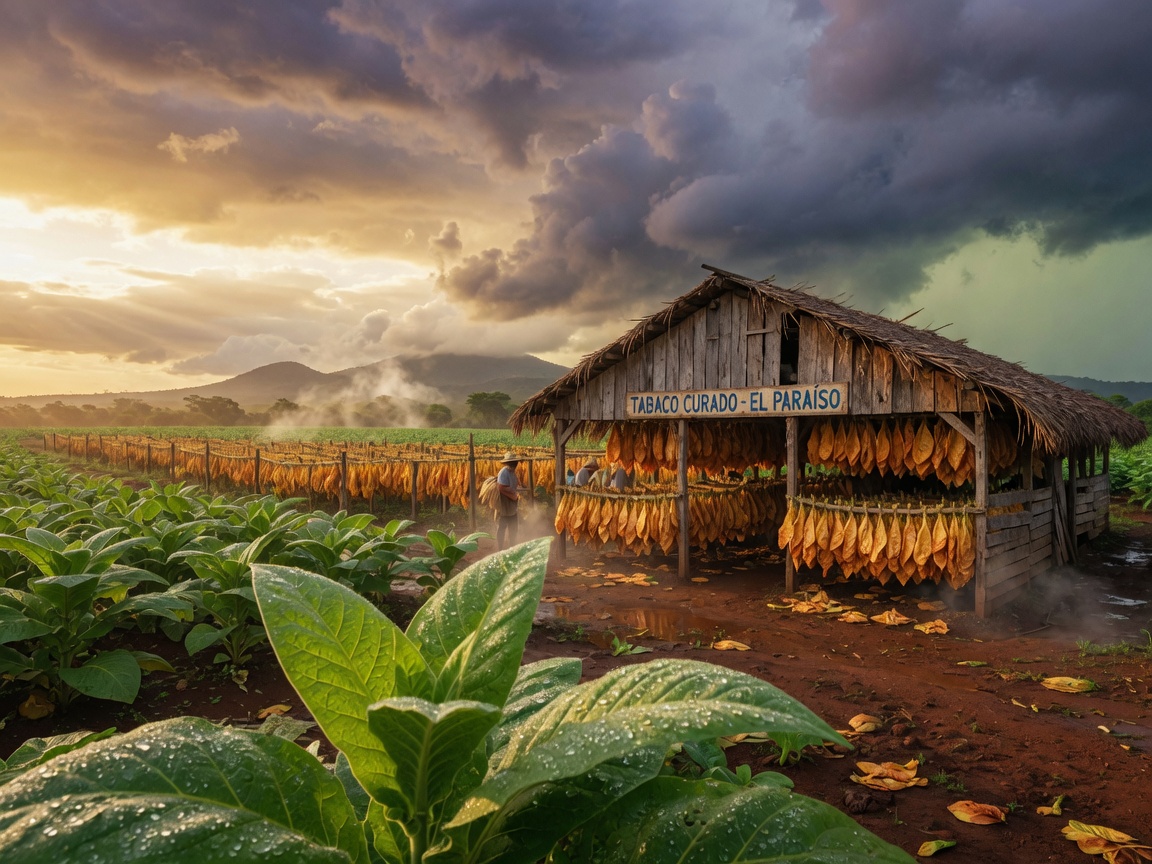
Standing at the edge of a tobacco field in Estelí, Nicaragua, at an altitude of about 800 meters, the complex sensation of dry earth mixed with the impending seasonal humidity always instantly pulls me back to those decisive harvest seasons. As an agronomist who has spent twenty years working in Latin American tobacco regions, I know deeply that tobacco is not just a plant that grows in the soil — it is more like a "climate recorder." The Cibao Valley of the Dominican Republic and the Estelí and Condega regions of Nicaragua, though located in the same tropical/subtropical climate belt, have completely different artistic responses to meteorological data.
Cibao Valley, Dominican Republic: The Rhythm of Tropical Stability
In the Cibao Valley of the Dominican Republic, tobacco production is more like a precise dance under a stable rhythm. The climate here is typical tropical, with an average annual temperature stable around 24°C. Although diurnal temperature variation exists, it is not extreme.
For our transplanting period starting in late October, the stability of the Cibao Valley is our greatest asset. According to years of monitoring, precipitation in this region peaks around October and May, while January to March is relatively dry. This seasonal pattern directly determines the growth logic of tobacco. During the rapid growth period from November to March of the following year, we rely heavily on irrigation from rivers (such as the Yaque River), because although precipitation is moderate during this period, evaporation is relatively high.
I have observed in the fields of the Cibao Valley that if we encounter abnormal precipitation during the harvest window from February to March (e.g., monthly rainfall exceeding 40 mm), the maturity of tobacco leaves presents a kind of "false prosperity." Excess moisture promotes rapid nitrogen absorption, causing leaves to appear lush green and thick. However, because the conversion rate of starch to sugar is diluted by moisture, the leaves ultimately struggle to achieve that ideal deep amber color during the subsequent air-curing process, and the aroma layering becomes thin.
In the Cibao Valley, our technical core lies in "control." Utilizing stable daytime temperatures (27-31°C) and relatively moderate humidity (68-78%), we manage precise irrigation to ensure that by the time tobacco enters the harvest period in February, the leaves have completed a perfect transition from vegetative growth to maturity.
Nicaragua: A Quality Gamble Under Extreme Climate
If the Dominican Republic represents stable rhythm, then the tobacco regions of Nicaragua — especially Estelí — represent a gamble on "extremes."
The reason why Nicaraguan tobacco quality stands out in the international market is largely due to its pronounced alternation between dry and wet seasons, as well as significant diurnal temperature variation brought by altitude. In Estelí, we experience a typical tropical savanna climate. Here, the dry season (December to April) and wet season (May to November) are clearly demarcated, providing a perfect logic for tobacco growth and maturation.
During the dry season from January to April, Estelí's average daily temperature ranges from 21-24°C, but note that early morning minimum temperatures often drop to 17°C or even lower. This significant diurnal temperature variation is the key to "flavor alchemy." Lower nighttime temperatures slow down plant respiration, allowing sugars, starches, and alkaloids (such as nicotine) accumulated through photosynthesis during the day to be more efficiently deposited in leaf tissue rather than consumed. This is also why Nicaraguan tobacco leaves tend to have a more robust, oilier character.
However, this quality is built upon extremely stringent risk management. Once the end of the dry season (usually April or May) overlaps with the arrival of seasonal precipitation, the situation becomes extremely tricky. In Estelí, April rainfall is typically only about 40 mm, but once May arrives, monthly precipitation rises sharply to over 200 mm.
The Logical Chain of Meteorological Parameters and Physiological Maturity
To understand why meteorological data is so important, we must delve into the underlying logic of plant physiology. Tobacco maturation is a process that progresses upward from the bottom leaves.
First is the temperature threshold effect. For tobacco, 21-29°C is the "golden range" for growth. During Nicaragua's rapid growth phase (50-70 days after transplanting), if daytime temperatures persistently exceed 35°C, I immediately observe whether the leaf edges show signs of scorching. High temperatures force the plant into a "stress-induced maturity" state, where rapid maturation under pressure leads to loose leaf tissue structure, insufficient thickness, and extremely unbalanced chemical composition.
Second is the water-nitrogen competition. Precipitation directly affects nitrogen mobility in the soil. During the rapid growth period, we need sufficient water to support leaf expansion; but during the ripening stage, water management must become "stingy." If heavy rain occurs at this stage, excess nitrogen triggers "re-greening" — a phenomenon where leaves that have already tended toward maturity absorb too much nitrogen and re-initiate vegetative growth. This is disastrous for tobacco farmers, as it not only damages leaf color but also reduces the nicotine-to-sugar ratio, making the leaves "light and frivolous."
Finally, humidity's control over microorganisms. During the wet season in Nicaragua, relative humidity often soars above 80%. In this environment, tobacco's greatest enemy is not drought but mold (such as blue mold). High humidity not only affects growth but directly threatens the post-harvest drying process.
Technical Adjustment Plans for Seasonal Harvesting
Based on the above meteorological patterns, our operational logic in different seasons is completely different:
1. Dry Season Harvest (Main Window):
From January to April in Nicaragua, our focus is on "precision graded harvesting." Due to the dry environment, leaf moisture content is low, and thanks to diurnal temperature variation, the leaves have accumulated sufficient oils. We strictly harvest layer by layer based on leaf color changes and "snap." The technical focus at this stage is to ensure that harvested leaves quickly enter the drying barn, utilizing the low-humidity environment for natural air-drying, thereby locking in that pungent and deep aroma.
2. Wet Season/Transition Period Harvest (Risk Window):
If meteorological fluctuations delay harvesting to May, our technical strategy must shift to "emergency harvesting and mold prevention." At this point, due to high humidity, we can no longer harvest leaf by leaf in a leisurely manner as in the dry season. Instead, we must increase harvesting frequency and shorten leaf exposure time in the field. At the same time, we pay more attention to selecting harvesting height, prioritizing the most mature lower leaves, and strengthening ventilation and humidity monitoring in the drying barn to prevent mold caused by excessive humidity.
Crisis in Practice: The Spring Rain That Changed Decisions
I will always remember an experience in Estelí in April 2018.
That year's dry season was longer than usual, and the tobacco maturity looked ideal. Most farmers planned to complete large-scale harvesting by mid-April. However, just as we were preparing for the final large-scale harvest, an extremely abnormal monsoon-like rainstorm struck the entire region. Three consecutive days of heavy rainfall turned Estelí's originally dry soil into mud instantly, and monthly precipitation reached twice the April average in just a few days.
At that moment, standing in the field looking at the yellow-green alternating leaves with extremely high moisture content, I faced an agonizing decision: wait for the weather to clear, giving the leaves time to complete their final chemical transformation? Or immediately initiate "emergency harvesting"?
If we waited, the extremely high humidity and soil waterlogging would immediately trigger root rot. More severely, excess precipitation would cause leaf "re-greening," destroying the hard-earned quality. But if we harvested immediately, because the leaves had excessively high moisture content and had not yet reached perfect "snap," we would likely harvest a batch of "soft leaves" with insufficient quality stability, prone to discoloration during drying.
In the end, I recommended a "tiered emergency harvesting" strategy: immediately harvest all lower leaves that had reached maturity indicators, conduct preventive harvesting of middle leaves, and utilize all available drying equipment to increase drying barn turnover. That decision, although it sacrificed some "purity" in quality, successfully saved the entire season's tobacco yield and avoided the risk of total crop loss from large-scale mold.
Conclusion: Finding Balance in the Cracks of Climate
For tobacco experts, meteorological data is not cold numbers — it is the baton of planting decisions.
The stability of the Dominican Republic provides the confidence for large-scale production, while Nicaragua's extreme climate provides the soul of high-quality tobacco. Understanding how precipitation, temperature, and humidity act physiologically on every leaf, we can find the optimal path connecting natural patterns and commercial quality in the gaps of seasonal change. Growing tobacco is, in essence, an art of reaching a settlement with the climate.
Dominican Republic · Cibao Valley
- Annual avg 24°C, stable climate
- Moderate diurnal variation, not extreme
- Bimodal rainfall Oct/May, dry Jan-Mar
- Core strategy: precise irrigation control
Nicaragua · Estelí
- Dry season 21-24°C, dawn as low as 17°C
- Pronounced diurnal variation, flavor key
- Apr 40mm → May surges to 200mm+
- Core strategy: emergency harvest & mold prevention
* Air-curing: a traditional process of hanging tobacco leaves in ventilated barns for natural drying
* Re-greening: phenomenon where mature leaves re-initiate vegetative growth due to excess nitrogen